In February 2026, the Indian government released its annual Union Budget with major changes that could reshape how healthcare is delivered, accessed, and experienced by millions of patients across India. This blog explains what the key reforms mean for everyday patients, especially those seeking pain management, long-term care, and specialised therapies — just like what we focus on here at Return Pain Free Physiotherapy Clinic.
1. Bigger Healthcare Budget — More Resources, Not Always Lower Bills
For the first time, India’s national healthcare budget has crossed a significant milestone — over ₹1 lakh crore — showing that the government views healthcare as a critical area for growth, employment, research and technology.
However, many experts warn that higher allocations don’t automatically translate into lower costs for patients. Medical inflation and out-of-pocket spending remain key concerns, especially for treatments and diagnostics not fully covered by insurance or public schemes.
What this means for you:
- More funds can improve infrastructure, but treatment costs may still rise due to inflation in private care and diagnostics.
- On the positive side, there’s a push to make essential medicines (like cancer drugs) cheaper and more accessible.
2. Regional Medical Hubs — A New Way of Delivering Care
A major highlight of Budget 2026 is the plan to create five Regional Medical Hubs across India. These are designed to be integrated health complexes that bring together:
- Modern medical services
- Diagnostics and rehabilitation
- Traditional systems like AYUSH (Ayurveda, Yoga, Unani, Siddha, Homeopathy)
- Post-treatment care
These hubs are also expected to boost medical tourism and create jobs for doctors, therapists, technicians, caregivers and allied health professionals.
For patients, this means:
- Better continuity of care from diagnosis through rehabilitation
- Availability of multiple therapy options, including non-drug pain and lifestyle management
- Stronger regional healthcare access beyond large cities
3. Focus on AYUSH & Integrative Medicine
The Budget announced three new All India Institutes of Ayurveda and support for AYUSH pharmacy and training facilities.
AYUSH systems promote preventive care, physical well-being and lifestyle approaches — all of which align with physiotherapy goals like reducing pain without heavy reliance on medications.
Patients interested in holistic care will have more options combining modern rehabilitation with traditional therapies.
4. Mental Health Gets a Boost — NIMHANS-2 Comes to North India
For the first time, the government emphasised mental healthcare infrastructure by planning a second national institute for mental health (NIMHANS-2) in North India and upgrading existing regional centres.
Why this matters:
- Reduces mental health treatment gaps
- Better access for patients outside major metro cities
- More focus on stress-related conditions — a big factor in chronic pain and musculoskeletal disorders
Mental well-being is deeply connected to physical healing — so these investments could have indirect benefits for patients with ongoing pain, injury recovery, and chronic conditions.
5. Allied Health Professionals Get a Major Role
The Budget lays out plans to support training in 10 allied health disciplines, including applied psychology, optometry, anesthesia technologists and more — with a target to train 100,000 allied health professionals over the next five years.
That’s great news for physiotherapy and pain-management clinics because:
- More trained professionals means shorter wait times
- Higher quality rehabilitation services
- Broader availability of supportive therapy teams
6. The Cost & Insurance Reality
Despite the reforms, many patients still struggle with rising medical bills and insurance premiums — a point raised by families and advocacy groups during Budget discussions.
Key concerns include:
- High GST on hospital charges still affecting overall bills
- Rising insurance premiums
- Continued out-of-pocket costs for many treatments
This reminds us that while government policy is improving the structure of healthcare, patient advocacy and smart use of insurance remain critical.
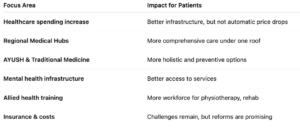
What This Budget Means for You (Summary)
Conclusion
The Union Budget 2026–27 shows that healthcare is no longer sidelined — it’s becoming central to national development, inclusive growth, and patient-centred care. While cost pressures still exist, the focus on integrated services, mental health, allied health training and traditional medicine provides new pathways for pain management and rehabilitation.
At Return Pain Free Physiotherapy Clinic, we believe these reforms have the potential to make quality pain relief and rehabilitation more accessible, whether through better local healthcare networks or stronger allied health support — all aimed at helping you live better, move better, and pain-free.